
The Mirror XR Seeds workshop is a foundational program for students in Years 5-6, guiding them on their foundational formative experiences as a digital native—helping students define the 'digital space' and exploring different tech tools while learning essential emotional literacy and safe online interactions, allowing students to define the social and emotional interactions in the digital world.
This webpage will show a step-by-step demonstration of Mirror XR Seeds in-classroom delivery in a sequential manner. This document will show a representation of the activity being delivered in the workshop, how it was build stemming from evidence-base, curriculum alignments, and pilot program implementation results.
Every layer of delivery, the curriculum alignment, the interaction design, the sequencing of content, the choice of when AI facilitates and when a teacher does, is built on a specific evidence base, not on convention or convenience.
Nothing in Mirror XR is there because it's trend-driven or because it looks engaging on the surface. Each design choice traces back to a reason, and the pilot data, completion rates, engagement patterns, what the delivery revealed, is what lets us say, with evidence rather than assertion, that the reasoning holds up in a real classroom.
Foundational Principles
Every learning experience is mapped to the F–10 Australian Curriculum V9 and the South Australian Certificate of Education (SACE), so teachers can confidently integrate Mirror XR without adding extra workload or straying from core outcomes.

Mirror XR is not just about using the latest tools; it transforms how students learn by combining cutting-edge research in AI, XR, gaming psychology, and education into hands-on, curriculum-aligned activities. This approach turns emerging academic findings into practical strategies that work in real classrooms.

Designed and developed in consultation with clinical psychologists and mental health professionals, Mirror XR prioritises student wellbeing, helping to create safe, positive learning experiences that support emotional as well as academic growth.

Our program meets the standards of the eSafety Commissioner, the National Mental Health Commission’s National Children’s Mental Health and Wellbeing Strategy, and the South Australian Digital Strategy 2023–2026, ensuring schools stay ahead while meeting local and national guidelines.
Mirror XR is built to grow alongside your school. We refine the program not only through teacher feedback, but also by staying ahead of curriculum changes, incorporating the latest research, and adapting to new policies and technologies. This way, schools can trust Mirror XR will always stay relevant, effective, and ready for the future.
Mirror XR Seeds F-10 Australian Curriculum V0.9 Alignment
The workshop's lessons in recognising emotions through digital contexts builds the skills to manage emotions and understand how emotional responses shape interactions (AC9HP6P06), while its consent and respectful-behaviour role-play content develops students' ability to seek, give, or deny consent and communicate intentions respectfully (AC9HP6P07).
The safety and privacy content (knowing who to trust, what's private, when to take a break) has students investigating health information sources relevant to their own choices (AC9HP6P09) and analysing how behaviours affect health, safety and wellbeing (AC9HP6P10).
Mirror XR Seeds frames the "digital space" and identify what tools are for reflects defining problems with given design criteria (AC9TDI6P01), while exploring how Mira.AI responds and structuring prompts touches on the decisions and logic underlying algorithms (AC9TDI6P02).
Evaluating existing safety features builds the evaluation skill of assessing whether a solution gives students adequate safety tools (AC9TDI6P06), and the "no data collection" privacy framing directly teaches digital footprint and data-privacy awareness (AC9TDI6P10).
The generative AI artwork activity is where Mirror XR Seeds meets Media Arts outcomes. Having students prompt generative AI to create artworks and then implement ideas, purpose and meaning into those creations reflects using media languages and technologies to construct works that communicate meaning for an audience (AC9AMA6C01), while how AI and immersive tools are used and understood connects to exploring how media languages and technologies function across different contexts (AC9AMA6E01).
Mirror XR SA Wellbeing Programs Directory Domains Alignment

Mental health literacy is taught directly through Mirror XR Quest's "Digital Mental Health Literacy" learning outcomes, where students learn to describe digital wellbeing, understand AI safety, and articulate themes like self-worth and resilience. Mental wellbeing is addressed through the program's core "Focus on Digital Wellbeing" value proposition, which treats safe digital habits as an emotional skill rather than purely a technical one.

Mirror XR's Whole-of-School Approach is built specifically around this domain, through research that positive teacher-student and parent-child relationships drive engagement and resilience, and structuring the program so teachers and parents are equipped to sustain these relationships rather than leaving students to navigate digital life alone.
At the classroom level, Seeds and Quest build social skills directly by teaching students to recognise emotions in digital interactions, and Quest explicitly examines how online social dynamics affect peer belonging.

This domain maps most directly onto Mirror XR Horizon, built around "dream-building", connecting students' self-awareness of their talents and passions to future career aspirations, alongside stress-management strategies that support motivation under academic pressure.
Cognitive skills are built throughout the pathway via the Digital Technologies curriculum content (understanding algorithms, evaluating AI output, prompt engineering), and future aspirations are supported end-to-end through Horizon's career content, its micro-credential pathway into Mirror XR Vanguard.

Cyber safety and gaming in Mirror XR is grounded in gaming psychology principles, teaches safe AI and immersive-tech use, and aknowledges gaming-related escapism and digital addiction as the core problem it was built to prevent. Self-esteem is addressed through Quest's exploration of self-worth, imposter syndrome, and online social comparison.
The Mirror XR Seeds workshop is a foundational program for students in Years 5-6, guiding them on their foundational formative experiences as a digital native—helping students define the 'digital space' and exploring different tech tools while learning essential emotional literacy and safe online interactions, allowing students to define the social and emotional interactions in the digital world.
The Mirror XR Seeds Pilot Program was ran with St Peter's Girls' School on 1st of September, 2026 Year 5-6 students.
Interactive Learning
Mirror XR Seeds leverages the media in which students already live in a day-to-day basis. Interactive learning engage students actively in the learning process through multimedia elements, promoting deeper cognitive engagement by allowing students to have their own agency to interact with contents and apply simulated knowledge in real-time, increasing understanding, motivation, and improving learning outcomes (Ibrahim et al., 2026; Rashidova, 2026)
Moreover, Rashidova (2026) found that teaching a same lesson but with a well-designed visual and interactive learning materials as a method of delivery such as interactive storytelling, quizzes, drag-and-drop activities, simulations, and instant feedback mechanisms, increased participation and in turn, reinforced learning outcomes.
The Mirror XR Seeds pilot is a living evidence of these research, achieving a 100% student completion rate across the core interactive modules, and facilitators/teachers directly noted full student engagement in the interactive elements.
Gamified learning
Every clickable element in Mirror XR Seeds is built to look and behave like something from a phone home screen or app interface, not like a classroom worksheet. Large tappable icons and cards (a camera, a smartphone, a treasure box, a block button) rather than text menus or dropdowns, because recognisable visual language lowers the barrier to engagement, students don't need instruction on how to use the interface, they already know how to tap an icon Rashidova (2026).
Interactive tools are shown to boost engagement precisely through this kind of playful, low-friction interactivity, offering students the opportunity to learn while having fun and evaluate themselves interactively through gamification, and interactive teaching formats more broadly, leading to better engagement and outcomes than static delivery.
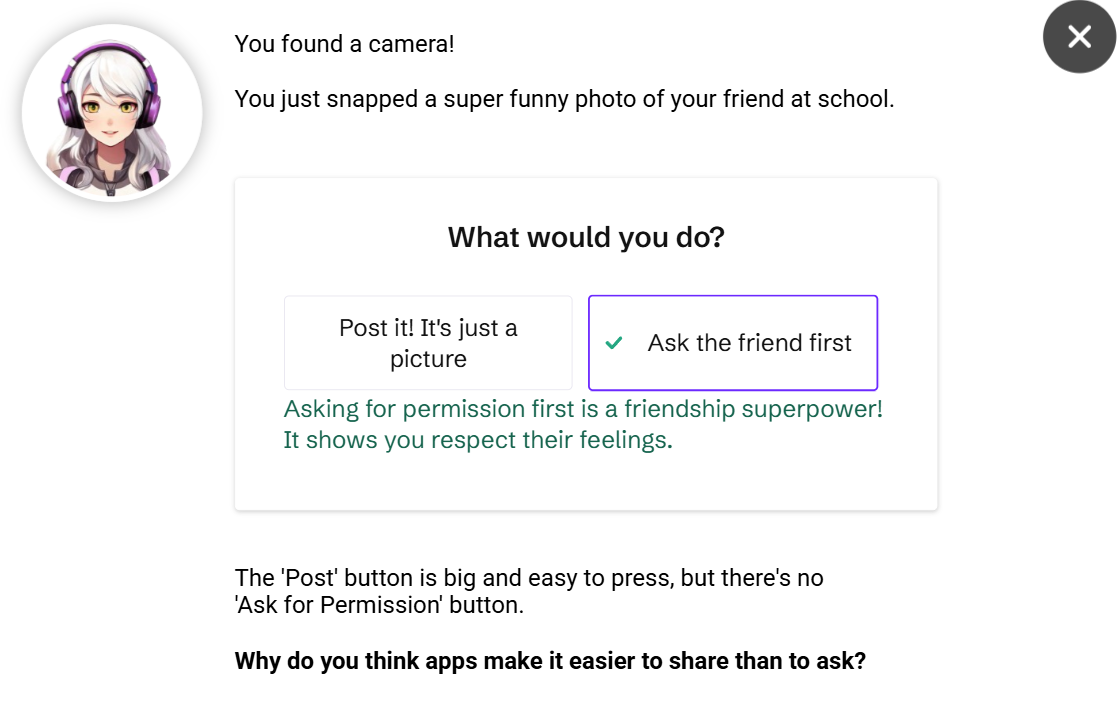
One example of interactable in the workshop shows a familiar object triggering a simulated consequence: tapping a "Like" sticker or a treasure box opens a real decision (post or ask first? enter your name or don't?) that surfaces the hidden mechanic behind that action. Choices are deliberately reduced to simple decision points rather than open text or complex branching. Critical thinking begins with simple experiences such as observing a difference, encountering a puzzling question or problem, and questioning someone's statement, and progresses to more complex experiences such as applying higher-order thinking skills such as reasoning, questioning, and evaluating alternative explanations (Citations_______).
Students are also shown a grid of clickable app icons spanning social media, AI companions, online games, and XR, and prompted to tap the ones they personally use. On the program pilot, this single interaction became one of the most-interacted features in the entire workshop, confirming a high baseline of digital activity, excitement, and interest, with students recognising and/or engaging in social media (with TikTok and Snapchat being the most recognised), gaming environments (Minecraft & Roblox being the most played), and AI Chatbots (ChatGPT being the most recognised).
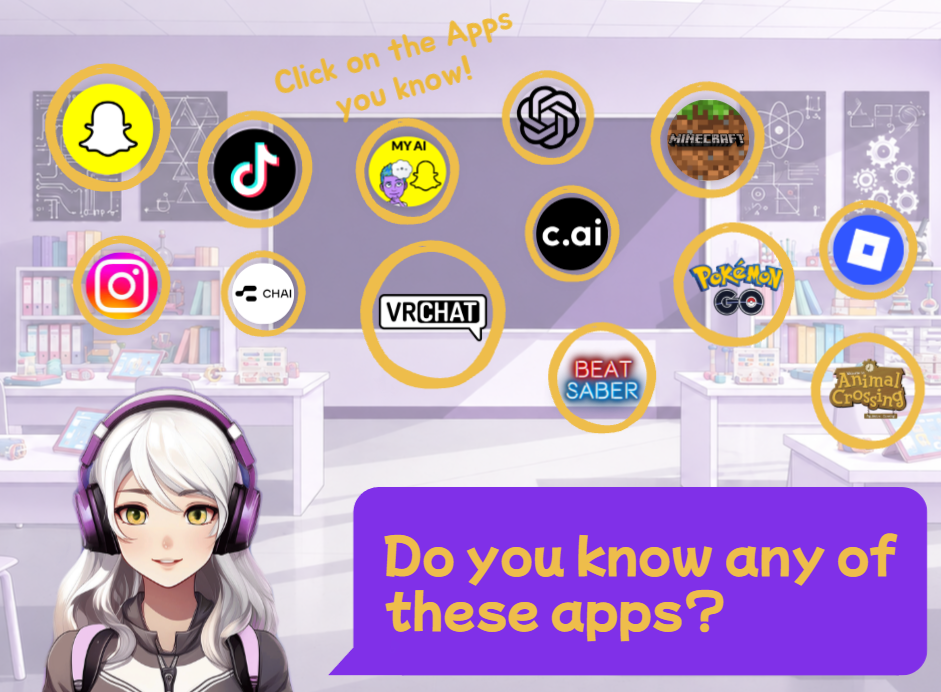
That the highest-engagement moment of the whole session, the one built to look most like a real digital activity, is a direct, if single-instance, signal that the familiar-interface design choice and just the content behind it.
Mira.AI & Generative AI
AI tools give students interactive, real-time dialogue that challenges them to apply knowledge to realistic scenarios, developing analysis, synthesis and evaluation skills rather than passive recall. Artificial Intelligence-powered tools provide students with interactive learning experiences and challenge them to apply their knowledge to real-world problems, enabling them to develop skills such as analysis, synthesis, and evaluation (Citations______).
Furthermore, generative AI fosters creativity and exploration. It develops ideas stemming from students, and helps them see different possible perspective and iterations. When done right and focused in a certain scope (i.e. using generative AI to get poetry ideas), this would amplify the students (Ivcevic & Grandinetti, 2024).
AI-powered conversational tools specifically encourage critical thinking through contextually relevant responses rather than static, one-way instruction natural language processing tools facilitate meaningful discussions between students and virtual assistants or chatbots by encouraging critical thinking through contextually relevant responses (Turker & Ozturk, 2024).
In the pilot, when a network inference forced a pivot away from the live Mira.AI-facilitated activity to a teacher-led Q&A, students with iPads still in hand occasionally derailed and lost focus while classmates presented their answers, a loss of attention the debrief attributes directly to Mira not being operational to facilitate. This is a direct, observed data point on what happens in its absence.
The pilot shows that students are engaged with Mira.AI after its introduction by the Mirror XR Facilitators, asking it ice-breaking questions to get to know Mira.AI better. However, it should be noted that there is always a need for a directed conversation or specific topics to achieve the intended program outcomes and prevent conversations from drifting.
Students Peer Discussion
Mirror XR Seeds reflects collaboration skills by making students co-author a single message to Kira together, so the "shared responsibility" with collaborating being the intention of the activity (Turker & Ozturk 2024; McCrindle, 2025). Utilising collaboration in the learning process allows students to bring together their knowledge, skills, and experiences to better understand and sparks ideas, questions, and learn from each other, with the two main characteristics of collaboration in the learning process being that students are grouped and gain knowledge through interaction with their peers (Turker & Ozturk 2024).
In the pilot, the Flashcards activity was run as small-group peer discussion — students grouped in 2–3, given a flashcard prompt to discuss together, and tasked with returning a shared answer. This is structurally the same collaborative mechanic Helping Kira with Mira is built on: peer discussion converging on one co-authored response, rather than individual reflection. Helping Kira asks students to apply that same collaborative structure to a more emotionally loaded task — validating and reframing a peer's self-doubt. The pilot evidences that students can productively do the format in a group, it doesn't yet evidence that the emotional-support content lands the same way when run through that format.
Intergenerational Gap
Pre-pilot discussions anticipated a low level of student engagement with digital platforms. What surfaced in the workshop was the opposite: students recognised or actively used ChatGPT, Minecraft, TikTok, Roblox, Snapchat, and other digital apps with continued daily engagement on platforms while Australia's under-16 social media restrictions are in effect. Teachers experienced this scale of student digital engagement only as an on-the-spot discovery during the workshop itself, not as prior knowledge they brought into the session.
Awareness is the first step toward change, and this is precisely where the gap sits. It is not only that teachers were unaware which apps and games students actually use, the workshop's interactive delivery format demonstrated that students already navigate digital interfaces fluently and intuitively, and the 100% completion rate across the core interactive modules indicates the format also supported content retention, not just surface engagement.
This matters because how this generation learns best is itself documented, and it does not entirely match a traditional, teacher-directed model. McCrindle's (2025) generational comparison identifies Gen Alpha's leadership style as "inspiring", a slight shift from Gen Z's "empowering" style, but differs from the top-down models earlier generations were taught under. Generation Alpha and Gen Z don't need the same authority structures, hierarchies, or traditional power approaches, because we're in more collaborative times, adding that entrusting them with opportunities to grow, and allowing them to experiment and fail, is key to building the learning capability this generation needs.
If teachers, who spend the most educational time with students, are initially unaware of these active digital habits, parents are naturally left with even less visibility at home without someone pointing it out or being empowered to independently inquire on their children's digital lives.
References
Ibrahim, N., Safitri, D., Marini, A., Pratama, I., & Marfu, A. (2025). Education sustainability through interactive modules and learning autonomy to improve self directed learning among middle school students with PLS SEM random forest and XGBoost. Discover Sustainability, 7(1). https://doi.org/10.1007/s43621-025-02508-8
McCrindle. (2025). Understanding Generation Alpha. generationalpha.com
Rashidova, E. (2026, February 25). STRATEGIES FOR DESIGNING VISUAL AND INTERACTIVE LEARNING MATERIALS FOR CHILDREN AND TEENS. https://asiansciencejournal.org/index.php/AJSRI/article/view/102
Türker, P. M., & Öztürk, M. (2024). Generative Artificial intelligence and the 4C learning skills for the 21st century. In Advances in educational technologies and instructional design book series (pp. 285–320). https://doi.org/10.4018/979-8-3693-7220-3.ch011

We create the best learning environment for students by turning their classroom into a game world. Through guided play, we enhance their creativity and technical skills but also train them to navigate their world e.g. spot red flags and mitigate risk.
Bridging the gaps between digital and physical worlds by equipping Gen Z with digital literacy knowledge and the right skill set to engage with technology responsibly and protect their wellbeing in virtual space.

It’s not a child's responsibility to look after themselves this in a whole new, constantly changing world. To protect them, we must first understand their world. It takes a whole society to raise a thriving physically and mentally.